Thursday, May 26, 2011

Book Review – Hawking’s The Grand Design

“Stephen Hawking’s A Brief History of Time remains a top seller after 22 years, paralleling his surprising longevity with amyotrophic lateral sclerosis. This new book, written with Mlodinow (also a theoretical physicist and trade-book author), despite its grand claim says little new, except for providing a surface-level update on the speculative M-theory as well as joining the fashionable ‘Ditchkinses’ in providing naïve jabs at religion….

“Hawking & Mlodinow approach deep spiritual, metaphysical, ontological, and existential questions, but instead of seriously engaging them, they apply superficial physical-reductionistic answers. This is not surprising, given Hawking’s habit of ridiculing religion as outmoded myth, but it is sad nevertheless; I had hoped that he and Mlodinow would have learned from both atheist and Christian critiques of Dawkins and Hitchens. Apparently there remains a significant market for sloppy dismissal of anything to do with faith….

“Hawking and Mlodinow display extreme philosophical and theological naïveté, beginning with their announcement that ‘philosophy is dead’….

“The goal of the book was to answer ‘the Ultimate Question of Life, the Universe, and Everything,’ which they state as: ‘Why is there something rather than nothing? Why do we exist? Why this particular set of laws and not some other?’ (p. 10). These are good questions, but scientists and the general public, Christian or otherwise, will not receive reliable answers in this failed attempt by Hawking and Mlodinow.”

The above are snippets of my review of The Grand Design, which has been published in the June 2011 issue of Perspectives on Science & Christian Faith; read the entire review here or here, it is also listed in our “Collected Papers”.

Tuesday, May 24, 2011

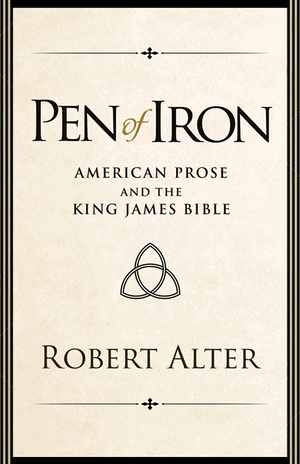
Book Review - Pen of Iron: American Prose and the King James Bible

The influence of the King James Bible upon the English language and culture is immense. This year, a number of books have been produced to mark the 400th anniversary of the publication of the King James Version. We have found Tim DeJong, a doctoral student of English, willing and able to review Robert Alter’s Pen of Iron: American Prose and the King James Bible, which originated as the 2008 Spencer Trask Lectures at Princeton University. Alter is currently a professor in Hebrew and Comparative Literature at the University of California-Berkeley, where he has taught since 1967. He is the author of numerous books and articles and a recognized expert in ancient Hebrew. In 2007 he published an English translation of the Psalms.

DeJong, who previously reviewed Marilynne Robinson’s Absence of Mind for Reformed Academic, introduces and critiques Alter’s study, which reflects on how the KJV’s distinctive prose and themes have influenced the work of some of America’s great writers, including Melville, Faulkner, and Hemingway. We invite you to engage with DeJong’s review, which is listed in our “Collected Papers”; a direct link is here.

Wednesday, April 20, 2011

Children of God: The Imago Dei in John Calvin and His Context – A Review

Human beings, we read in Genesis 1, are created in God’s image and likeness. Throughout the centuries theologians have struggled with these terms, trying to ascertain their precise meaning. Some have concluded that they refer to the fact that humans, unlike other creatures, have the ability to reason and so to communicate with God. Others believe that they point to the human ability to establish relationships, and still others that they must be interpreted in a functional sense, referring to the fact that human beings were appointed as God’s vice-regents with the specific task of ruling the rest of creation.

Prominent among Reformed contributors to the discussion is the sixteenth-century reformer John Calvin, and it is his views that form the topic of the book now under discussion. The author, Dr. Jason Van Vliet, originally wrote it as a doctoral dissertation for the Theological University at Apeldoorn, The Netherlands (2009). A graduate of the Canadian Reformed Theological Seminary in Hamilton, ON (1996), he now serves at that seminary in the department of dogmatology. Van Vliet shows that Calvin dealt with the question of the divine image throughout his professional life and that his views developed over time. Calvin’s most important contribution, Van Vliet concludes, lay in his description of the image as referring to the relationship between a Father and his children (as also reflected in the title).

Books by theologians are usually reviewed by theologians. Since Van Vliet’s topic falls within the category of historical theology, however, it was also possible to assign the work of reviewing it to a historian. That is what we did when we asked Richard Oosterhoff to take up the challenge. As the review shows, we made the proper choice. Not only historians, but also theologians (as well as the interested lay person) will appreciate both the contextual framework our reviewer has provided and his informative, extensive, and balanced description and analysis of Van Vliet’s book.

Richard Oosterhoff is a native of southern Ontario and received his B.Sc., with double majors in Biology and Religion and Theology, from Redeemer University College (2005). Now a Ph.D. candidate in the Program in History & Philosophy of Science at the University of Notre Dame, he is writing a dissertation on how a group of Renaissance professors at the University of Paris, some of whom became French reformers, joined their passion for Christ and their piety with deep love of the liberal arts, especially the mathematical arts of the quadrivium. (If you wonder what the quadrivium is, just ask him – but be prepared to endure enthusiasm!) Richard was pleased to spend much of this winter researching in rare book libraries in Paris and southern California, but now that spring has brought daffodils to the Midwest he is very happy to be back in South Bend, Indiana, where he can again enjoy the warm fellowship of Michiana Covenant Presbyterian Church (PCA), which he, his wife Elora, and their two little girls had greatly missed during their travels.

The review is found in our “Collected Papers”; a direct link is here.